
Multilingual Video Marketing: AI Content Repurposing
Discover how AI-powered video translation and digital avatars help global brands repurpose content across 70+ languages with lip-sync technology—without reshooting or expensive production.
TL;DR: Global brands use AI-powered video translation with lip-sync technology to repurpose content across 70+ languages in minutes—without reshooting. This approach cuts localization costs by up to 80% while maintaining authentic viewer experiences across markets.
Video now drives an estimated 82% of global consumer internet traffic. For brands expanding internationally, multilingual video marketing has shifted from a nice-to-have to a competitive necessity. The challenge? Traditional localization methods—hiring voice actors, coordinating studios, managing translation teams—take weeks and cost thousands per language.
AI has changed the equation. Today's video translation tools combine voice synthesis, lip-sync technology, and digital avatars to transform a single source video into dozens of localized versions. Major brands report production efficiency gains of 80% or more. According to CSA Research, 76% of consumers prefer purchasing from websites offering information in their native language, making this capability directly tied to revenue growth.
This guide covers how AI video localization works, practical applications for e-commerce and enterprise teams, and how to implement multilingual video marketing without the traditional production overhead.
Why Multilingual Video Marketing Matters Now
The numbers tell a clear story. According to W3Techs, only about 53% of online content is in English, while just 25% of internet users speak English as their primary language. This gap represents massive untapped potential for brands willing to localize.
Consider these data points:
- 76% of customers prefer to buy products with information in their native language
- 40% of consumers never purchase from websites in languages other than their own
- 91.8% of internet users watch videos weekly, with 17 hours of video consumed on average
For cross-border e-commerce sellers on Amazon, Shopify, eBay, and Etsy, these statistics translate directly to conversion rates. A product video in German performs better in Germany. A tutorial in Japanese builds trust with Japanese buyers. The question is no longer whether to localize—it's how to do it efficiently.
How AI Video Translation Works
Traditional video localization required separate production for each language: script translation, voice talent booking, studio time, and post-production editing. AI video translation and dubbing compresses this entire workflow into minutes.
The process follows a straightforward pipeline:
- Source video analysis: AI extracts the audio track, transcribes speech, and maps facial movements
- Translation: The script is translated into target languages with cultural adaptation
- Voice synthesis: AI generates natural-sounding speech in each language, often cloning the original speaker's voice
- Lip-sync adjustment: The speaker's mouth movements are modified to match the new audio
- Output generation: Finished videos export ready for distribution
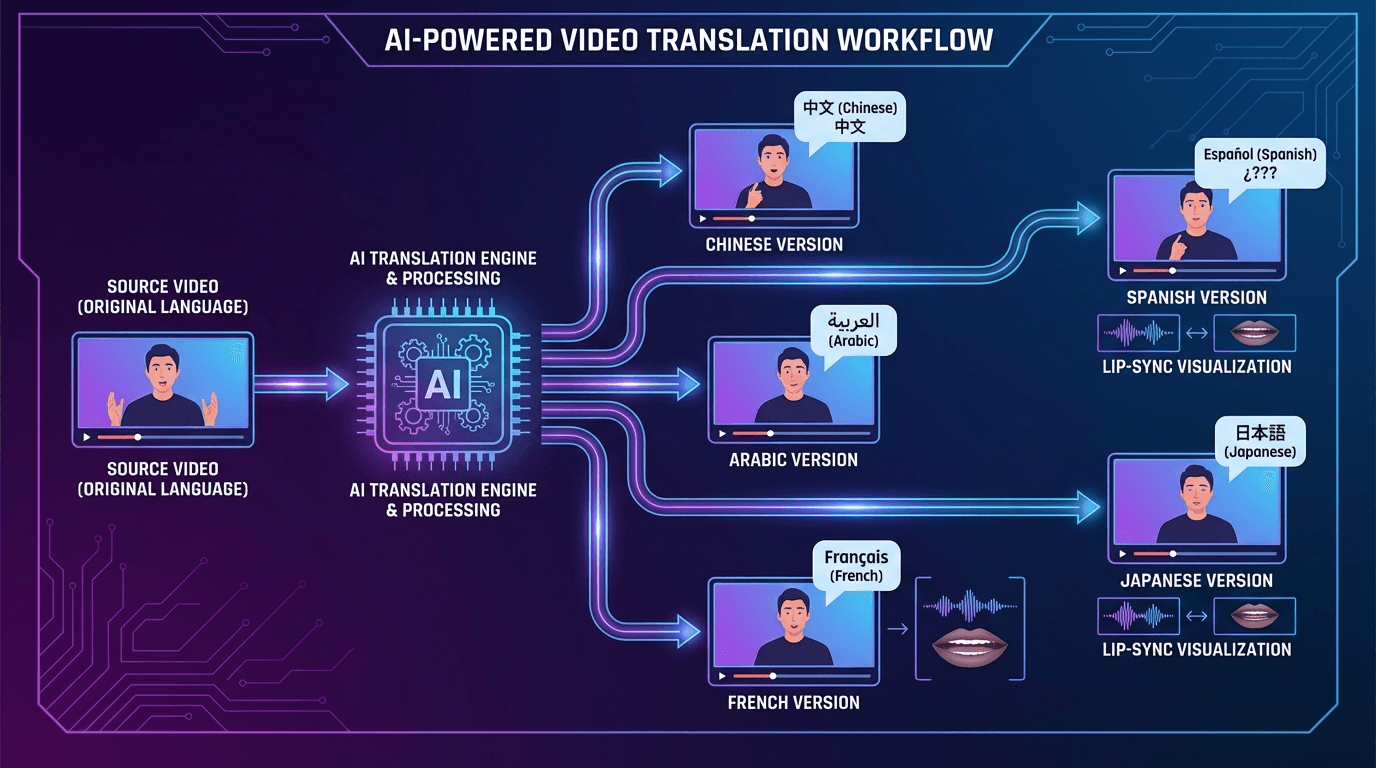
Modern platforms support 70+ languages with 178 dialects, covering major markets from Spanish and Mandarin to Arabic and Hindi. The lip-sync technology ensures viewers perceive the speaker as actually speaking their language—not watching a dubbed foreign film.
Tip: Start with your best-performing video content. AI localization amplifies what already works, so prioritize videos with proven engagement before scaling to your full library.
Digital Avatars and Voice Cloning
Digital avatars remove the need for on-camera talent entirely. These AI-generated presenters deliver your message with realistic facial expressions, gestures, and speech across any language. For brands producing high volumes of product videos, training content, or marketing materials, avatars offer consistent quality without scheduling constraints.
Avatar and voice cloning tools enable several powerful workflows:
- Brand spokesperson consistency: The same avatar represents your brand across all markets
- Rapid content updates: Change messaging without reshooting
- Batch generation: Produce dozens of product videos simultaneously
- Voice preservation: Clone a specific voice and use it across languages
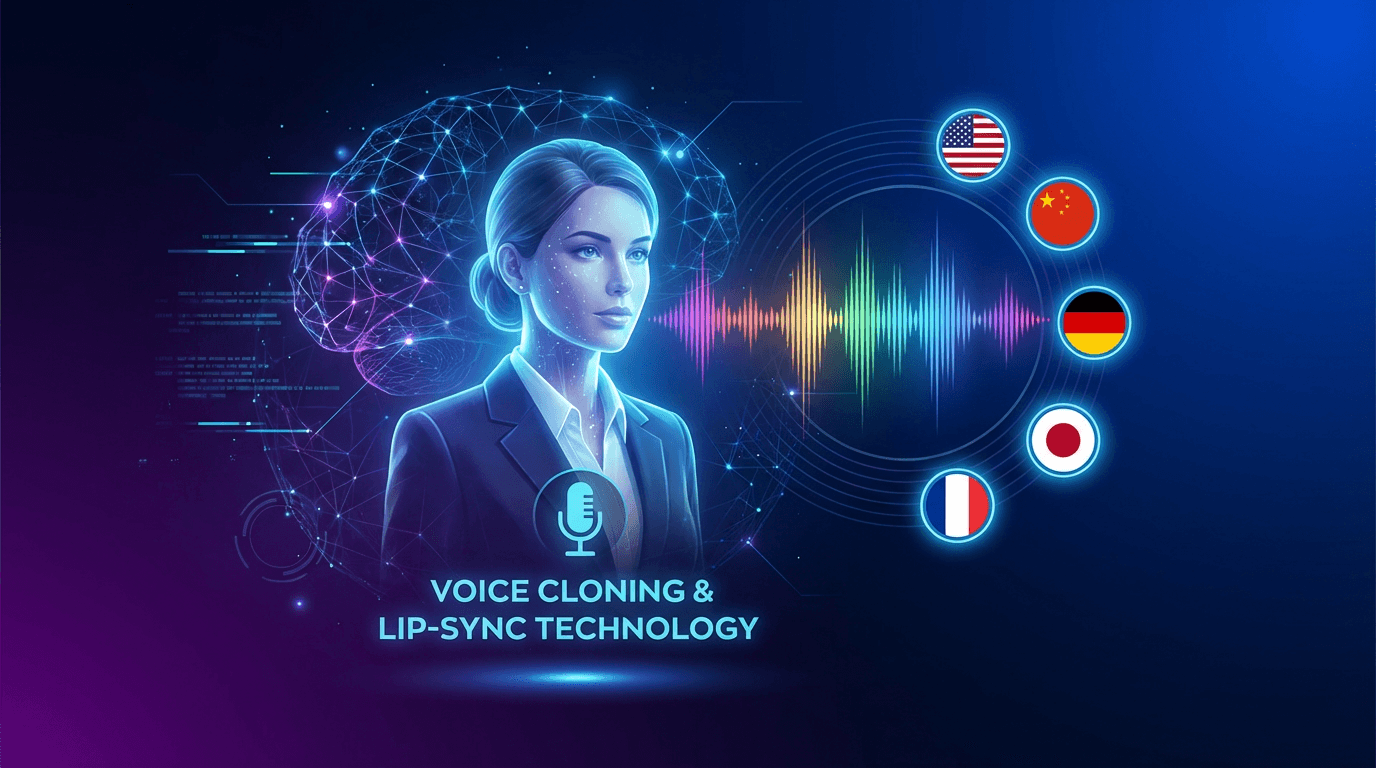
The technology has matured significantly. Today's digital avatars include 234+ diverse options representing different ages, ethnicities, and professional styles. Voice libraries offer 169+ options supporting regional variations—Latin American Spanish versus European Spanish, for example.
Maintaining Brand Voice Across Languages
Consistency matters when localizing. A common pitfall is losing brand personality during translation. Solutions include:
- Creating a brand glossary with preferred terminology in each language
- Using Translation Memory (TM) technology to maintain consistent phrasing
- Establishing tone guidelines translators can follow
- Reviewing output with native speakers in key markets
E-Commerce and Cross-Border Applications
For Amazon, Shopify, eBay, and Etsy sellers, multilingual video marketing directly impacts sales velocity. AI product video creation transforms product listings into video content, which can then be localized for each marketplace.
Practical applications include:
- Product demonstrations: Show features in the buyer's native language
- Unboxing and reviews: Build trust with localized social proof
- How-to tutorials: Reduce returns by explaining usage clearly
- App store previews: Localize Google Play and Apple App Store videos
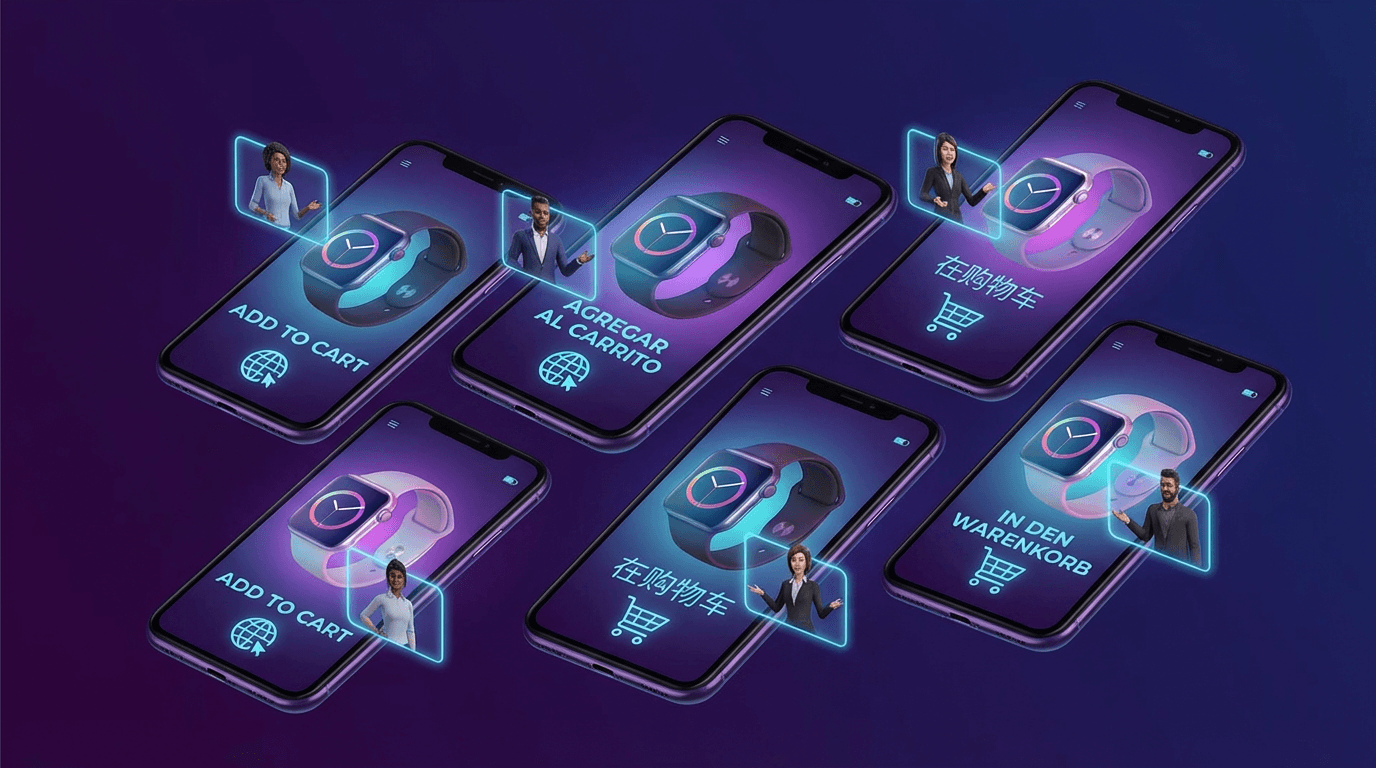
The workflow for e-commerce sellers typically starts with a product URL. Platforms can extract product information, generate a conversion-focused script, and produce videos optimized for each marketplace—all within minutes rather than days.
Tip: Localize your product video descriptions, tags, and metadata alongside the video itself. Video SEO in each target language improves discoverability on YouTube and marketplace search results.
Enterprise Training and HR Content
Corporate teams face similar challenges at larger scale. Global companies need onboarding materials, compliance training, and internal communications in multiple languages. AI localization enables:
- Consistent training delivery across regions
- Rapid updates when policies change
- Cost-effective production without regional film crews
- Accessibility through multilingual subtitles and voiceovers
Platform-Specific Optimization
Each distribution platform has unique requirements. YouTube and TikTok favor different video lengths, aspect ratios, and engagement patterns. A multilingual video marketing strategy should account for these differences.
YouTube: Supports multiple audio tracks and subtitle files, allowing viewers to select their preferred language. Optimize titles, descriptions, and tags in each target language for search visibility.
TikTok: Short-form content requires tighter localization. Cultural references and humor often need complete adaptation rather than direct translation. Consider creating region-specific cuts.
E-commerce marketplaces: Amazon, Shopify, and Etsy each have video specifications. Ensure localized videos meet technical requirements for each platform.
Social media: Instagram Reels, Facebook, and LinkedIn each serve different audience segments. Adapt not just language but content style for each platform's user expectations.
Getting Started with Multilingual Video
Implementation follows a logical sequence. Begin by converting ideas to video with your core messaging, then scale localization based on market priority.
Step 1: Audit existing content Identify videos with strong performance that would benefit from localization. Product demos, explainers, and testimonials typically translate well.
Step 2: Prioritize languages Focus on markets with the highest revenue potential. For most Western brands, Spanish, French, German, and Portuguese offer strong ROI. For Asia-Pacific expansion, Mandarin, Japanese, and Korean are priorities.
Step 3: Choose your approach Decide between AI-only localization, human-reviewed AI output, or hybrid workflows depending on content sensitivity and brand requirements.
Step 4: Establish quality control Implement a review process with native speakers for critical markets. Even excellent AI output benefits from human verification on cultural nuances.
Step 5: Measure and iterate Track engagement metrics by language and region. Use data to refine which content types and markets receive localization investment.
Frequently Asked Questions
How much does AI video translation cost compared to traditional dubbing?
AI video translation typically costs 70-90% less than traditional studio dubbing. Traditional localization can run $1,000-5,000 per language per video, while AI platforms often charge per minute of content with monthly subscription options that make batch processing economical.
Does lip-sync technology work for all languages?
Modern lip-sync technology handles most major languages effectively, though results vary by language pair. Languages with similar mouth movement patterns (European languages) typically produce the most natural results. Asian languages require more sophisticated adjustment but current tools handle them well.
Can I use AI-localized videos for regulated industries like healthcare or finance?
Yes, but with appropriate review. AI translation provides a strong foundation, but regulated content should pass through compliance review with native speakers before publication. Many enterprises use AI for initial drafts and human experts for final approval.
How long does multilingual video localization take with AI?
Most AI platforms deliver localized videos in minutes rather than days. A 3-minute product video can be translated, dubbed, and lip-synced into 10 languages within an hour. Traditional localization of the same content might take 2-4 weeks.
Conclusion
Multilingual video marketing has become accessible to brands of all sizes. AI-powered translation, digital avatars, and lip-sync technology eliminate the traditional barriers of cost, time, and complexity. For e-commerce sellers, enterprise teams, and marketing agencies, this means reaching global audiences with native-language content at unprecedented speed.
The brands gaining market share in 2025 are those treating localization as a core capability rather than an afterthought. With tools that convert product URLs to multilingual videos in minutes, the competitive advantage goes to those who move first in each market.
