
Video Subtitle Translation: Automated vs Manual Methods
Discover the key differences between automated AI and manual video subtitle translation methods, including accuracy rates, costs, and best use cases for each approach.
TL;DR: Video subtitle translation can be done manually (high accuracy but expensive and slow), automatically with AI (fast and cost-effective but may need editing), or through a hybrid approach combining both methods. Automated solutions now achieve 85-98% accuracy and cost under $1 per minute, while manual translation can exceed $5 per minute with 2-3 day turnarounds.
Breaking into global markets requires more than great video content; you need multilingual subtitles that resonate with diverse audiences. Video subtitle translation transforms your content from single-language productions into globally accessible assets, but choosing between automated and manual methods can significantly impact your budget, timeline, and quality outcomes.
The subtitle translation landscape has shifted dramatically in 2026. AI-powered tools now handle 70+ languages with lip-sync capabilities, while traditional manual services maintain their edge in cultural nuance. Understanding which method fits your project determines whether you spend days or minutes localizing content, and whether you pay $5 or $0.25 per video minute.
Understanding Video Subtitle Translation Methods
Video subtitle translation converts spoken dialogue from one language to another, displaying the translated text as on-screen captions. This process enables viewers who don't speak the source language to understand your content, expanding your reach across linguistic barriers.
Three primary methods dominate the video subtitle translation space: manual translation by professional linguists, automated AI-powered translation, and hybrid approaches that blend human expertise with machine efficiency.
Why Subtitle Translation Matters
According to research from multiple industry sources, adding subtitles in multiple languages directly impacts video performance. Multilingual subtitles boost viewer engagement, increase watch time, and improve SEO rankings as search engines index subtitle content across languages.
Cross-border e-commerce merchants report higher conversion rates when product videos include subtitles in their target market's language. Educational platforms see improved completion rates, and advertising agencies achieve better campaign performance with localized video content.
Manual Subtitle Translation: The Traditional Approach
Manual video subtitle translation relies on professional translators fluent in both source and target languages. These linguists listen to audio, transcribe dialogue, translate text while preserving context and cultural meaning, then sync subtitles with video timelines using specialized software.
Professional translators deliver exceptional accuracy, typically achieving 99% precision according to industry benchmarks. They understand cultural nuances, idioms, and context that automated systems often miss. Manual translation excels with content-heavy videos, culturally sensitive material, and industry-specific terminology.
However, manual subtitle translation demands significant time investment. According to SubCaptioner, typical turnaround times span 2-3 days minimum, with costs often exceeding $5.00 per minute of video. Scaling manual translation presents challenges when localizing content into multiple languages simultaneously.
Automated Subtitle Translation: AI-Powered Solutions
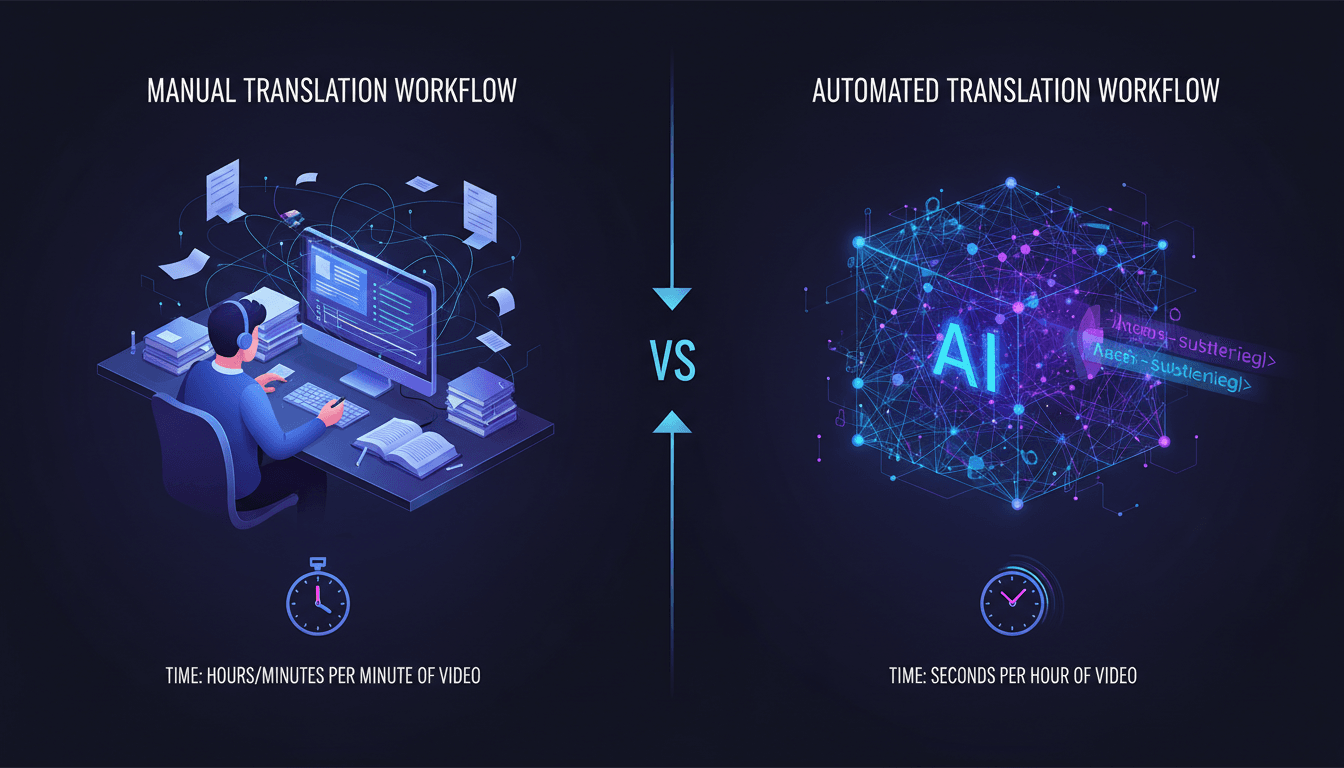
Automated video subtitle translation leverages artificial intelligence to detect speech, transcribe audio, translate text, and generate synchronized subtitles within minutes. AI tools now support 100+ languages with accuracy rates between 85-98%, depending on the platform and language pair.
How Automated Translation Works
AI subtitle translators use speech recognition to convert audio to text in the source language, apply neural machine translation to convert text into target languages, then automatically sync translated subtitles with video timelines. Advanced platforms like Keevx add lip-sync technology that matches avatar mouth movements to translated audio in 70+ languages.
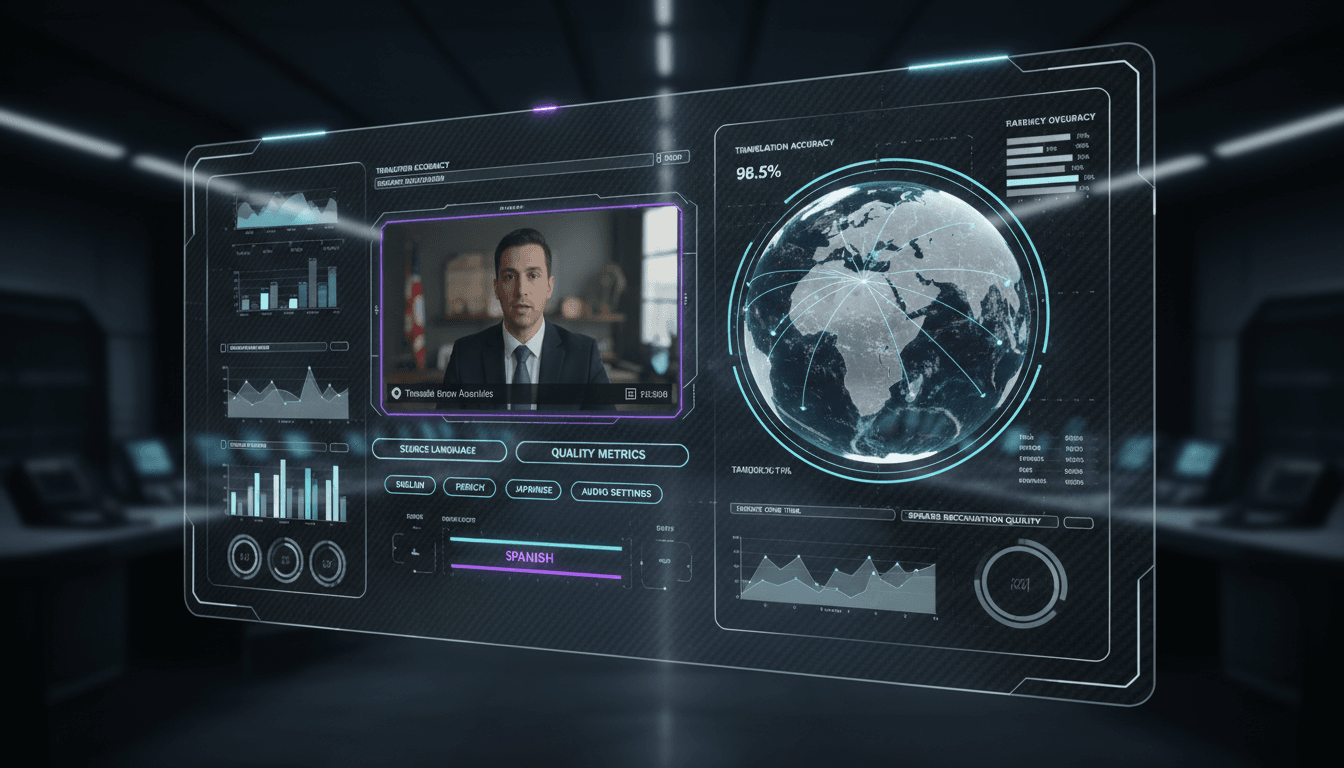
According to Happy Scribe and Zeemo AI, modern AI translation systems achieve 85%+ to 98% accuracy respectively, making them suitable for most commercial applications.
Benefits and Limitations
Speed defines automated translation's primary advantage. What takes days manually happens in minutes with AI tools. Cost efficiency follows closely; automated services typically charge $0.25-$1.00 per minute compared to $5+ for manual translation.
Keevx stands out in the automated translation space by combining video translation and dubbing with digital avatar technology. The platform enables minute-level production timelines, supports 70+ languages with 178 dialects, and integrates directly with e-commerce platforms through one-click URL to video conversion.
While convenient, automated subtitle translation occasionally lacks nuanced contextual accuracy. AI struggles with culturally specific references, wordplay, sarcasm, and industry jargon. According to Lokalise, AI cannot watch the video to understand visual cues, tone shifts, or emotional context that inform proper translation.
Hybrid Translation: Combining Human and Machine Strengths
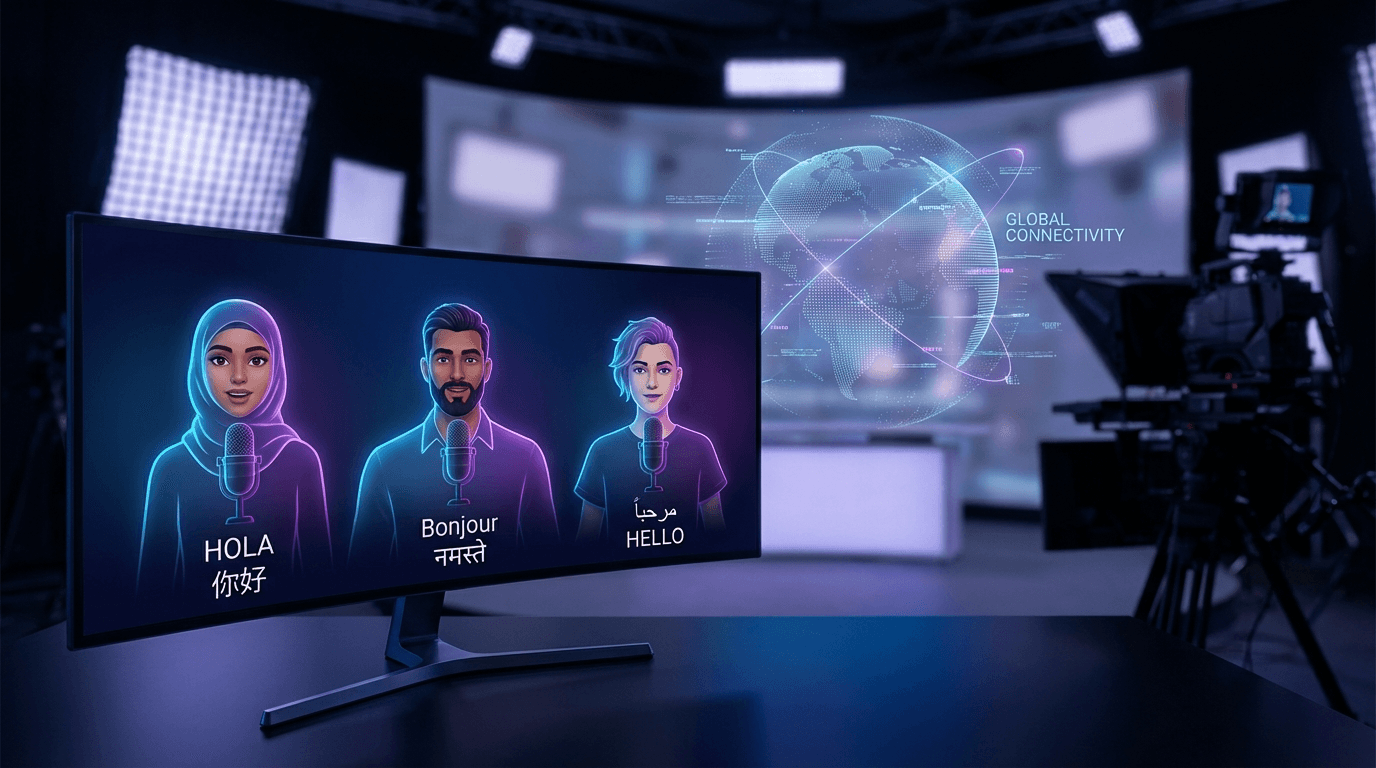
The hybrid approach has gained significant traction in 2026, combining AI speed with human quality assurance. This method uses automated tools to generate initial subtitle translations, then brings in human reviewers to refine accuracy, fix contextual errors, and ensure cultural appropriateness.
AI performs the initial heavy lifting by transcribing audio and translating subtitles. Professional translators then review the output, correct mistakes, adjust timing, and refine translations to match the intended tone and cultural context. This division of labor dramatically reduces translation time compared to fully manual workflows while maintaining higher quality than pure automation.
Hybrid translation balances cost, speed, and quality effectively. You achieve faster turnarounds than manual-only methods at lower costs, while maintaining accuracy that exceeds pure AI translation. According to Transpalm, this approach has become the recommended standard for professional video localization.
Key Factors When Choosing Translation Methods
Budget and Timeline
Manual translation costs vary by language pair and complexity but typically start at $3-10 per video minute. According to GoLocalise and Verbolabs, subtitle translation rates generally range from $0.18-0.25 per word or 3-8 euros per minute.
Automated solutions offer flat-rate pricing or subscription models with costs under $1 per minute per language. Platforms like Kapwing and Happy Scribe provide free trials allowing you to test quality before committing.
Manual translation requires days to weeks depending on video length and language count. Automated translation delivers results in minutes to hours. Hybrid approaches fall between pure automation and full manual service, typically charging 30-50% less than manual-only translation.
Accuracy and Content Type
Content type determines necessary accuracy levels. Legal, medical, financial, and compliance videos require near-perfect translation accuracy, making manual or hybrid methods essential. Marketing and social media content tolerates minor imperfections if the core message translates correctly, allowing pure AI solutions to suffice.
According to comparative analysis, machine translation achieves approximately 80% accuracy while human translation reaches 99% accuracy. Modern AI tools from providers like HeyGen and Descript now exceed 85% accuracy, closing the gap significantly.
Platform Tools for Video Subtitle Translation
Keevx leads in combining translation with AI-powered video production. The platform's video translation and dubbing feature supports 70+ languages with lip-sync, while its AI avatar technology enables creators to produce localized videos with digital humans speaking target languages naturally. Integration with e-commerce platforms allows one-click conversion of product URLs into multilingual video ads.
When selecting a platform, prioritize language coverage matching your target markets, accuracy rates suitable for your content type, editing capabilities for post-translation refinement, export format compatibility with your distribution channels, and pricing models that align with your volume needs.
Best Practices for Quality Subtitle Translation
Keep subtitles concise, limiting lines to maximum 42 characters per line and two lines per frame according to subtitling best practices. Viewers read slower than they listen, so condense translations while preserving meaning.
Good subtitle translation focuses on conveying meaning and emotion appropriately for target audiences, not literal word-for-word conversion. Adapt idioms, slang, and cultural references to equivalent concepts in the target language.
Watch the full video with translated subtitles rather than reviewing text alone. This catches timing issues, reading speed problems, and cases where translations don't match visual content. Even AI translations benefit from human review in the actual video context.
Translated subtitles improve video SEO across multiple languages. According to Subly, search engines index subtitle content, so translated videos appear in search results for keywords in each target language.
Frequently Asked Questions
Can I translate video subtitles for free?
Several platforms offer free trials or limited free translation. According to Happy Scribe, you can translate the first 10 minutes free, while Kapwing provides free access with limited minutes. HeyGen offers 3 videos up to 3 minutes each per month on their free plan.
How accurate is AI video subtitle translation?
Modern AI subtitle translation achieves 85-98% accuracy depending on the platform and language pair. Happy Scribe reports 85%+ accuracy while Zeemo claims 98% accuracy. Quality varies with content complexity. For critical content requiring near-perfect accuracy, combine AI translation with human review.
Can I edit automatically generated subtitle translations?
Yes, most platforms include built-in subtitle editors. Tools like Clideo allow you to adjust timing, text, and formatting after automatic translation generates initial subtitles. This editing capability makes hybrid workflows possible.
How many languages can AI translate video subtitles into?
Leading AI video translation platforms support 100-175+ languages. Canva supports 134 languages, HeyGen covers 175+ languages and dialects, and Keevx specializes in 70+ languages with 178 dialect variations and includes lip-sync technology.
Which subtitle translation method should I choose?
Choose manual translation for legal, medical, or financial content requiring 99% accuracy or culturally sensitive material where nuance matters critically. Select automated translation for high-volume content libraries, tight deadlines, budget-conscious projects, or straightforward content like product demos. Opt for hybrid translation when you need professional quality at reduced cost and faster turnaround than pure manual methods.
Conclusion
Video subtitle translation has evolved from a purely manual process requiring days and substantial budgets to an AI-powered capability delivering results in minutes at fraction of traditional costs. Manual translation still excels for content demanding perfect accuracy and cultural nuance, while automated solutions like Keevx enable global content distribution at unprecedented speed and scale.
The hybrid approach emerging in 2026 combines the best of both worlds: AI handles the time-consuming transcription and initial translation, while human review ensures quality meets professional standards. Your choice between manual, automated, or hybrid video subtitle translation ultimately depends on your specific content requirements, budget constraints, and timeline pressure.
Ready to transform your video content for global audiences? Start Free Trial and experience AI-powered video translation with lip-sync in 70+ languages.
